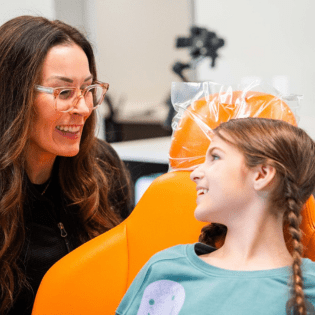
You’re scrolling through vacation photos when something catches your eye. Your daughter’s smile looks a little different than you remembered. Maybe it’s the way her front teeth overlap, or how her jaw seems to shift when she grins. Or perhaps it’s dinnertime, and you notice your son chewing only on one side again. It could be the sound of your child breathing through their mouth while they sleep, or the way they’ve been complaining that biting into an apple hurts.
Whatever brought you here, you noticed something. And that instinct matters more than you might realize.
Studies show that parents are often the first to recognize signs a child needs orthodontics — not dentists, not teachers, but moms and dads paying attention during everyday moments. Research published in pediatric dental journals confirms that parents are fairly accurate at spotting when “something is off,” particularly for visible concerns like crowding, spacing, and bite issues. The American Association of Orthodontists recommends that every child have their first orthodontic evaluation by age 7, but the truth is, many of those evaluations happen because a parent noticed something first.
This guide is written for parents like you. The ones scrolling through photos at midnight wondering if what they’re seeing is normal. The ones watching their child eat and thinking, “Should I be worried about that?” You don’t need a dental degree to trust what you’re observing. You just need a little clarity on what those observations might mean — and what to do next.
No pressure. No panic. Just honest information from a practice that understands what it’s like to worry about your child.
You Noticed Something — And That Matters
Here’s something most orthodontic websites won’t tell you: your gut feeling is usually right.
Parents tend to spot orthodontic concerns during what researchers call “visually loaded moments.” These are the times when teeth, jaws, and facial structure become more noticeable — photos where the smile looks crowded or off-center, laughing moments that reveal a deep overbite or crossbite, mealtimes when chewing looks awkward or one-sided. You might notice your child’s lips don’t quite close at rest, or that they breathe loudly through their mouth at night.
According to a study in the journal Clinical Oral Investigations, parents with higher health awareness are particularly good at identifying esthetic issues like crooked teeth, protruding front teeth, and visible crowding. But here’s the part that might surprise you — even parents without any dental background pick up on these things. The challenge isn’t noticing. It’s knowing what to do with what you’ve noticed.
Pediatric dentists and orthodontists view observant parents as partners in care, not pests. Dr. McClaran, a father of four himself, often tells families that parental concern is one of the most reliable referral sources he sees. When a mom says “something looks off,” she’s usually onto something worth examining. The question isn’t whether your instinct is valid — it almost always is. The question is whether that instinct points to something that needs attention now, later, or simply monitoring over time.
If you’ve noticed something about your child’s teeth, bite, or breathing, you’re not overreacting. You’re doing exactly what a good parent does: paying attention.
Common Signs Your Child May Need Orthodontic Care
So what exactly should parents be looking for? The American Association of Orthodontists has identified several signs that indicate a child may benefit from an orthodontic evaluation. These aren’t reasons to panic — they’re simply signals that it might be time for a professional to take a closer look.
Crowded or overlapping teeth are among the most common signs parents notice first. When there isn’t enough room in the mouth for all the teeth to fit properly, they start pushing against each other, rotating, or coming in at odd angles. This often becomes visible around age 6 or 7 when permanent teeth begin replacing baby teeth. Crowding doesn’t just affect appearance — it can make brushing and flossing difficult, increasing the risk of cavities and gum problems down the road.
Gaps between teeth can also signal an issue, though not always. Some spacing is normal as baby teeth fall out and adult teeth come in. But persistent gaps, especially between the front teeth, may indicate a mismatch between tooth size and jaw size that could benefit from early intervention.
Bite problems are another category parents often recognize, even if they don’t know the clinical terms. An overbite means the upper front teeth stick out significantly over the lower teeth. An underbite is the opposite — the lower teeth sit in front of the upper teeth when the mouth closes. A crossbite occurs when some upper teeth fit inside the lower teeth rather than outside, which can cause the jaw to shift and lead to uneven wear. An open bite means the front teeth don’t touch at all when the back teeth are closed together, often caused by prolonged thumb sucking or pacifier use.
Speaking of habits, thumb sucking or finger sucking that continues past age 4 or 5 can affect how the teeth and jaws develop. The same goes for tongue thrusting, where the tongue pushes against the front teeth during swallowing. These habits aren’t unusual in young children, but when they persist, they can create orthodontic issues that are easier to address early.
Early or late loss of baby teeth is another indicator worth noting. Baby teeth typically fall out in a predictable sequence, and permanent teeth follow a similar pattern. When baby teeth are lost too early — due to decay or injury — the surrounding teeth can shift into the empty space, blocking the permanent tooth from coming in correctly. When baby teeth hang on too long, it may signal crowding underneath or delayed development that’s worth investigating.
Difficulty chewing or biting is something parents often observe at the dinner table. If your child avoids certain foods, chews only on one side, or complains that biting hurts, it could indicate a bite alignment problem. Children shouldn’t have to work hard to eat a sandwich or tear a piece of chicken.
Quick Reference: Common Signs Parents Notice
| Sign | What It Might Mean | When to Consider Evaluation |
| Crowded or overlapping teeth | Not enough space for permanent teeth | When permanent teeth begin erupting (age 6-7) |
| Gaps between teeth | Possible jaw/tooth size mismatch | If gaps persist after age 8 |
| Overbite (upper teeth protrude) | Jaw alignment issue | By age 7 or when noticeable |
| Underbite (lower teeth in front) | Lower jaw growth concern | As soon as noticed |
| Crossbite (teeth fit incorrectly) | Jaw shifting, uneven wear | By age 7 |
| Thumb sucking past age 5 | Can affect tooth/jaw development | If habit continues past age 5 |
| Early/late baby tooth loss | Space maintenance may be needed | When it occurs |
| Difficulty chewing | Bite alignment problem | When consistently observed |
Signs You Might Not Expect (But Shouldn’t Ignore)
Here’s where things get interesting — and where many parents are surprised to learn that orthodontics extends far beyond crooked teeth.
Mouth breathing is one of the most overlooked signs that something might need attention. When a child consistently breathes through their mouth rather than their nose, it’s not just a quirky habit. Chronic mouth breathing can actually change how the face and jaws develop over time. Research shows that children who mouth breathe often develop narrower dental arches, higher palates, and longer facial structures. The tongue, which should rest against the roof of the mouth and help shape the upper jaw, instead sits low — and the jaw develops accordingly.
But it goes deeper than facial structure. Mouth breathing is often a sign of airway restriction, which could be caused by enlarged tonsils, adenoids, allergies, or a narrow palate. When children can’t breathe well through their nose, they compensate by breathing through their mouth — and that compensation has consequences.
Snoring is another red flag that parents sometimes dismiss as cute or normal. It’s not. Snoring in children often indicates that the airway is partially obstructed during sleep. This can lead to fragmented sleep, reduced oxygen levels, and a cascade of daytime symptoms that parents might not connect to breathing at all.
This brings us to perhaps the most surprising connection: behavioral and focus issues. Children who don’t sleep well because of breathing problems often show up at school tired, irritable, and unable to concentrate. Some are even misdiagnosed with ADHD when the real issue is sleep-disordered breathing caused by structural problems in the mouth and jaw. A study published in the journal Pediatrics found that children with sleep-disordered breathing were significantly more likely to exhibit hyperactivity, attention problems, and behavioral difficulties than their peers.
Dark circles under the eyes, restless sleep, teeth grinding at night, frequent headaches — these can all be connected to how well (or poorly) a child breathes. And many of these issues can be addressed, at least in part, through orthodontic intervention that improves airway space.
At McClaran Orthodontics, we look at more than just how teeth line up. We consider how your child breathes, sleeps, and grows — because these things are all connected. A narrow palate doesn’t just cause crowding. It can restrict the airway, affect sleep quality, and impact daily life in ways that aren’t obvious until someone connects the dots.
Question: Can orthodontic problems cause my child to have trouble focusing at school?
Answer: Yes, in some cases. When children have airway restrictions caused by narrow jaws or palates, they may experience poor sleep quality that affects concentration, mood, and behavior during the day. Addressing the structural issues through orthodontic treatment can sometimes improve these symptoms significantly.
Why Early Signs Don’t Always Mean Early Braces
Here’s something that might ease your mind: noticing a sign doesn’t mean your child needs braces tomorrow.
One of the biggest misconceptions parents have is that an orthodontic consultation automatically leads to treatment. The reality is quite different. Studies show that only about 15 to 25 percent of children who see an orthodontist around age 7 actually need early intervention. The majority — somewhere between 70 and 80 percent — are simply monitored over time in what orthodontists call a “watch and wait” approach.
What does watch and wait actually mean? It means the orthodontist has identified that something is developing and wants to keep an eye on it. Maybe there’s mild crowding that might resolve as the jaw grows. Maybe there’s a bite issue that’s better addressed once more permanent teeth have come in. The orthodontist will schedule follow-up appointments every 6 to 12 months to track development and step in only if the situation warrants it.
This approach exists because orthodontists understand that timing matters. Some problems genuinely benefit from early treatment — severe crossbites, significant jaw discrepancies, habits that are actively causing damage. These are situations where waiting could make things worse or require more invasive treatment later. But many issues are better addressed during adolescence when most permanent teeth have erupted and growth patterns are clearer.
The American Association of Orthodontists recommends that age 7 evaluation not because every 7-year-old needs braces, but because that’s the age when orthodontists can see enough to make informed recommendations. The first permanent molars have typically come in by then, and the relationship between upper and lower jaws is becoming apparent. An early look allows for early planning — even if that plan is simply to wait.
Dr. McClaran often tells parents that an evaluation is not a commitment. It’s information. It’s the difference between wondering and knowing. And for the majority of families, knowing brings relief — because the answer is often “let’s watch this together and make sure it develops the way we want.”
Question: If my child is evaluated at age 7, does that mean they’ll get braces at age 7?
Answer: Not usually. Most children evaluated at age 7 don’t need immediate treatment. The purpose of an early evaluation is to identify potential issues and determine the best timing for intervention — which is often several years later.
What Happens at a First Orthodontic Visit
If you’ve never taken a child to an orthodontist before, you might be wondering what the visit actually involves. The good news is that it’s straightforward, quick, and completely pressure-free.
A typical first orthodontic consultation takes about 30 to 60 minutes, depending on whether diagnostic records like X-rays or digital scans are taken. The appointment usually begins with a conversation — the orthodontist or staff will ask about your child’s dental and medical history, any habits like thumb sucking or mouth breathing, and any concerns you’ve noticed at home. This is your chance to share what prompted the visit in the first place.
Next comes the examination itself. The orthodontist will look at your child’s teeth, checking alignment, spacing, and how they fit together when the mouth is closed. They’ll assess the jaw, looking at growth patterns, symmetry, and movement. They may ask your child to open wide, bite down, or move their jaw side to side. For most kids, this feels similar to a regular dental checkup — no discomfort, no scary tools, nothing to worry about.
Depending on the child’s age and what the orthodontist observes, X-rays or digital scans might be taken. Panoramic X-rays show all the teeth at once, including those that haven’t erupted yet, giving the orthodontist a complete picture of what’s happening below the gumline. Digital scans can create 3D models of the teeth without the gooey impressions some parents remember from their own childhoods.
After gathering this information, the orthodontist will sit down with you and explain what they’ve found. They’ll answer your questions, discuss whether treatment is needed now or later, and outline next steps. For many families, the next step is simply scheduling a follow-up visit in six months to monitor development. For others, it might be discussing treatment options and timing.
At McClaran Orthodontics, first consultations are complimentary because we believe every family deserves clear information without financial pressure. Whether your child needs treatment now, later, or not at all, you’ll leave knowing where things stand and what to expect going forward.
What to Bring to Your Child’s First Orthodontic Visit:
Your child’s dental and medical history, including any previous X-rays if available. A list of questions or concerns you want to discuss. Information about your dental insurance if you’d like to discuss coverage options. And most importantly, bring your child with an open mind — most kids find the visit easy and even interesting.
When in Doubt, Let’s Take a Look Together
If you’ve read this far, you’re probably still wondering whether what you’ve noticed is worth a phone call. Here’s a simple answer: yes.
There’s genuinely no downside to getting an early orthodontic consultation. If everything looks fine, you’ll have peace of mind and a baseline for future comparison. If something needs attention, you’ll catch it early when it’s often easier and less expensive to address. Either way, you’re making an informed decision based on professional evaluation rather than late-night internet searches that leave you more confused than when you started.
Parents sometimes hesitate because they worry they’re overreacting, or because they assume they should wait until all the baby teeth are gone. But here’s what orthodontists consistently say: if you’ve noticed something, you’ve done your job. The next step isn’t self-diagnosis or endless Googling. The next step is letting a professional take a look and tell you what they see.
The questions parents should ask at that first visit are straightforward: Is there an orthodontic problem, and if so, what is it? When would treatment be recommended, if at all? What happens if we wait? What can we do at home in the meantime? A good orthodontist will answer these questions clearly, without pressure, and with your child’s best interests at heart.
At McClaran Orthodontics, we see ourselves as partners with parents — not salespeople pushing unnecessary treatment. As a father of four, Dr. McClaran understands the balance between wanting to do everything right for your child and not wanting to overreact to every little thing. Sometimes the most reassuring thing an orthodontist can say is “this looks normal, let’s check again in six months.” And sometimes the most helpful thing is “I’m glad you came in — here’s what we can do.”
If you’ve noticed something about your child’s teeth, bite, breathing, or smile, trust that instinct. Schedule a complimentary consultation and let’s take a look together. No pressure, no obligation — just clear answers from a team that cares about your child’s health as much as you do.
Because when it comes to signs your child needs orthodontics, the most important sign is often the parent who notices something and decides to find out what it means.
Related Resources:
- Meet Dr. McClaran — Learn about our approach to family-centered orthodontic care
- Our Treatments — Explore the options available for children and teens
- Palatal Expanders — Understanding early intervention appliances
- Contact Us — Schedule your complimentary consultation
Sources:
- American Association of Orthodontists — Child Orthodontics
- PMC — Parental Awareness of Orthodontic Treatment Need
- PMC — Sleep-Disordered Breathing and Orthodontic Intervention